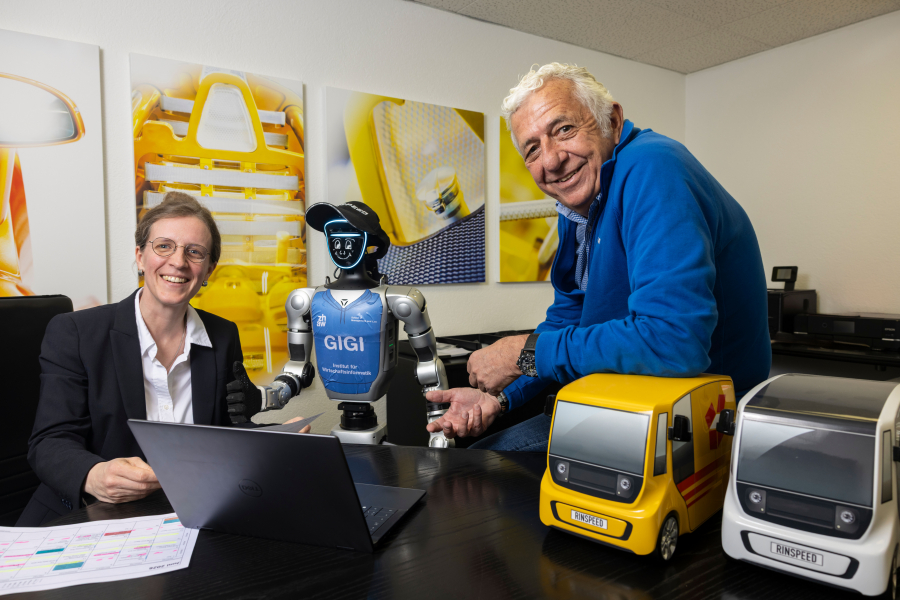
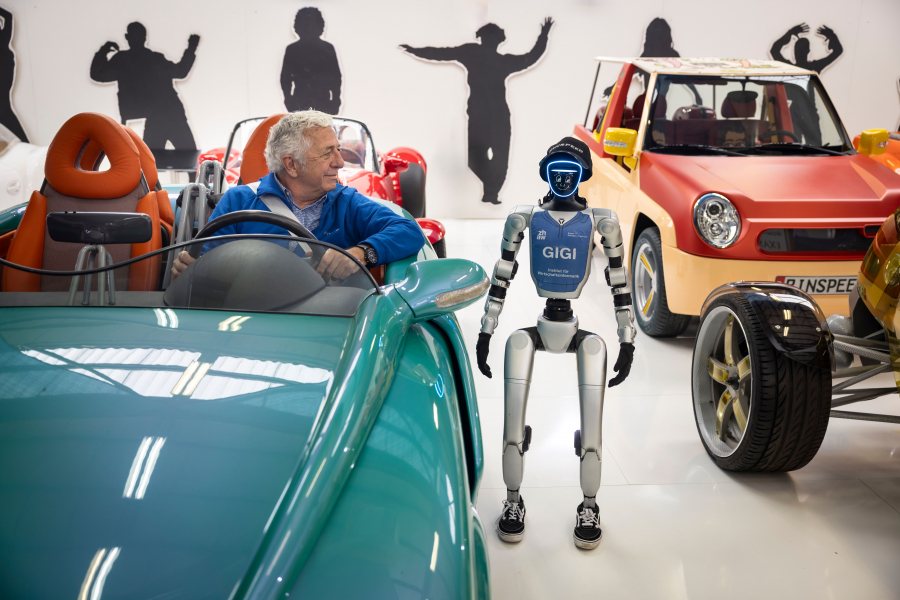
This Summer, Humanoid GIGI Embarks on the Tour de Suisse Robotique For decades, Frank M. Rinderknecht has stood for visionary mobility concepts and a consistent drive to think beyond existing boundaries. With the “Tour de Suisse Robotique,” the founder of mobility think tank Rinspeed is now bringing a new idea to the road: he is setting off on a journey across Switzerland with the humanoid robot GIGI—not as a demonstration object, but as an active participant engaging with people. The initiative combines technological questions with societal relevance. The focus lies on how humanoid systems are perceived outside controlled environments and what tangible value they can provide in everyday life. “We deliberately take innovation out of the lab and bring it to where it meets real expectations, reactions, and needs,” says Frank M. Rinderknecht. The project is scientifically led by Professor Theresa Schmiedel, Head of the Institute of Information Systems (IWI) at ZHAW School of Management and Law. Her team is further developing GIGI in the SIRA Lab, which focuses on social intelligence and responsible interaction. The humanoid robot is already capable of interacting with people and processing basic social signals. The journey now creates a framework to experience, test, and systematically expand these capabilities in a wide variety of contexts. In summer 2026, the Tour de Suisse Robotique will take GIGI to selected locations across the country, including leading academic institutions as well as partners from industry and society. Each stage opens up new perspectives—from technological developments and concrete application scenarios to broader societal questions. At the heart of the tour are authentic and often humorous encounters: conversations, demonstrations, and compact exchange formats will bring GIGI into direct contact with diverse people and environments. “This creates a continuous learning process on the path toward a personal assistant—one that not only steps in as a ‘spare wheel’, but proactively assists us, creating more space for human connections,” explains Schmiedel. The insights gained will directly feed into research at the IWI of ZHAW. At the SIRA Lab, Professor Alexandre de Spindler leads the development of GIGI: “For us, it is crucial that GIGI not only works technically, but also acts in a meaningful and understandable way in real-life situations.” The interactions throughout the tour will therefore be processed to further refine GIGI, enabling the robot to better adapt its behavior to different situations and expectations. With the “Tour de Suisse Robotique,” the result is less a technological demonstration and more a mobile laboratory—a journey in which not only a robot learns, but society itself learns how to engage with a new generation of technologies. Photos: Kurt Reichenbach / Schweizer Illustrierte
|
|||||||||||||||||||||||||||||||||||||



.jpg)

.jpg)
.jpg)
.jpg)

.jpg)


.jpg)

.jpg)